Well, I did it! I walked the bridge today, along with hundreds of thousands of others who did the same.
It was great, just great!
Sunday, March 18, 2007


Saturday, March 17, 2007
75th birthday of Sydney Harbour Bridge
Tomorrow Sydney celebrates the 75th birthday of the bridge. They're closing the road lanes for the whole day so people can walk over the bridge as a reenactment of the opening back in 1932. 200,000 people have registered to do the walk. I was too slow and so didn't register. However, I do intend to go into the city by train and participate in the celebration from The Rocks.
It could be a great time and lots of fun... I hope so.
It could be a great time and lots of fun... I hope so.
Health authorities issue masks to northerners
The pollution in Thailand's north is not abating. Lots of people are having trouble with breathing, sore eyes, and other ailments. They need a good thunderstorm to wash the air clear again... though maybe that's simplistic it usually seems to make a difference.
MCOT : Health authorities issue masks to northerners :

BANGKOK, March 16 (TNA) – Thailand's public health ministry has sent 300,000 additional masks to eight northern provinces shrouded in haze pollution, even as the provincial health authorities estimate that as many as two-thirds of local residents now have respiratory complaints, serious allergies and colds.
Deputy Public Health Minister Morakot Kornkasem led a team to visit patients with respiratory illnesses in hospitals in Lampang, Chiang Rai, and Phayao on Friday.
He said that the North's average level of the air pollution is still higher than the maximum permitted by health standards, and more patients come daily to receive medical treatment at the region's hospitals.
Dr. Morakot said in Lampang, dust particles were measured at 152.6 microgrammes per cubic metre, against the health standard of 120 microgrammes.
There were 1,578 patients with respiratory illness visiting the hospital from March 1-14, 2007. No severe illnesses were reported, but two-thirds had colds.
In Chiang Rai, some 12,000 cases of colds and eye irritation were reported. About 120,000 masks are needed for children, the elderly, and patients with asthma and heart disease.
Local residents are advised to avoid outdoor activities and to cover their noses and mouths with damp cloths to filter out the particle-laden air.
Deputy Prime Minister and Social Development and Human Security Minister Paiboon Wattanasiritham said in his capacity as chairman of the committee coordinating haze pollution response in the northern provinces that all bush fires will be contained in the north within three days.
When the situation improves, he said, long-term measures will be planned and implemented.
Air quality in many areas has improved, he indicated, stating that there is now no need to declare an environmental emergency as was earlier being considered as officials are bringing forest fires under control. (TNA)-E004
MCOT : Health authorities issue masks to northerners :

BANGKOK, March 16 (TNA) – Thailand's public health ministry has sent 300,000 additional masks to eight northern provinces shrouded in haze pollution, even as the provincial health authorities estimate that as many as two-thirds of local residents now have respiratory complaints, serious allergies and colds.
Deputy Public Health Minister Morakot Kornkasem led a team to visit patients with respiratory illnesses in hospitals in Lampang, Chiang Rai, and Phayao on Friday.
He said that the North's average level of the air pollution is still higher than the maximum permitted by health standards, and more patients come daily to receive medical treatment at the region's hospitals.
Dr. Morakot said in Lampang, dust particles were measured at 152.6 microgrammes per cubic metre, against the health standard of 120 microgrammes.
There were 1,578 patients with respiratory illness visiting the hospital from March 1-14, 2007. No severe illnesses were reported, but two-thirds had colds.
In Chiang Rai, some 12,000 cases of colds and eye irritation were reported. About 120,000 masks are needed for children, the elderly, and patients with asthma and heart disease.
Local residents are advised to avoid outdoor activities and to cover their noses and mouths with damp cloths to filter out the particle-laden air.
Deputy Prime Minister and Social Development and Human Security Minister Paiboon Wattanasiritham said in his capacity as chairman of the committee coordinating haze pollution response in the northern provinces that all bush fires will be contained in the north within three days.
When the situation improves, he said, long-term measures will be planned and implemented.
Air quality in many areas has improved, he indicated, stating that there is now no need to declare an environmental emergency as was earlier being considered as officials are bringing forest fires under control. (TNA)-E004
Thursday, March 15, 2007
Thailand's prime minister flies north for smog crisis talks
The smoke pollution situation in Thailand's north continues to be bad. Yesterday dust particles in the air measured at 400 microgrammes per cubic metre. The health standard is a maximum of 120 microgrammes per cubic metre.
A friend wrote today to say that a couple of days ago it hurt to breathe. The family keeps the doors and windows closed with the air conditioner and air filter going all the time.
The pollution is already affecting tourism. Who'd want to go visit a place where you can't see anything nor can you breathe?
Bangkok Post: Prime Minister flies north for smog crisis talks
A friend wrote today to say that a couple of days ago it hurt to breathe. The family keeps the doors and windows closed with the air conditioner and air filter going all the time.
The pollution is already affecting tourism. Who'd want to go visit a place where you can't see anything nor can you breathe?
Bangkok Post: Prime Minister flies north for smog crisis talks
Chiang Mai (TNA)
Prime Minister Surayud Chulanont will fly to Chiang Mai today to see for himself the smoke and haze now described as Thailand's worst airborne environmental disaster.
He is to escort royal supplies to be distributed to victims of the haze which is choking the northern provinces.
Chiang Rai Governor Amornpan Nimanant declared natural disaster areas in 16 districts and two subdistricts because of the smog.
He did not immediately say what his plans were. But declaring a disaster means he can dispense aid on an emergency basis, with little paperwork or involvement by the central government.
There is widespread criticism of the cabinet decision on Tuesday to give the smog problem another week to clear up before the government takes any action.
Dust particles caused by forest fires in this northern province have risen to their highest concentration in two weeks, measured Wednesday at nearly 400 microgrammes per cubic metre.
The highest level was measured at 383 microgrammes per cubic metre at Yupparatch Wittayalai in the provincial seat, compared to the health standard of a maximum of 120 microgrammes per cubic metre.
The regional environmental office reported the figure to the government, but solutions were not necessarily in sight.
The mayor of Chiang Mai municipality said the city is urging residents to spray water into the air by hoses to reduce dust particles and to increase moisture in the atmosphere.
The municipality is turning on fountains around the city, at historic moats and at other sites.
The province has banned all outdoor fires and has accelerated the activities of forest fire response teams, including using fire engines to spray water throughout residential areas to reduce the effects of the concentrated pollution.
Akkhanee Moonmek of the Love Chiang Mai Group said that the government's response was too slow to deal with the problem. "It ignored the problem and adopted a wait-and-see policy," he said
critically, suggesting the response was too little, too late.
He said the government should ban fires and declare an environmental emergency. It should also warn local residents of the health hazards posed by the dust.
The numbers of patients suffering from respiratory diseases has increased markedly throughout the region.
Dr. Pisit Sriprasert at Nan's provincial hospital said about 160 patients per day are visiting his hospital.
Nan forest fire control chief Muangman Kerdnana said the seasonal fires were expected to be critical due to severe drought. His firefighters are prepared to work around the clock, but are short
of necessary equipment for the numbers of workers needed.
Mai Sai district hospital director Dr. Sura Khunkongkhapan in Chiang Rai said many villagers are suffering from smoke-related respiratory diseases.
Patients from Thailand and Myanmar crossing the nearby border are coming to the hospital by as many as 100-200 people daily. Most of the patients are the elderly and children.
Northern region weather chief Thatsanee Chaichiengpin said a southwesterly wind is expected to move into the northern provinces and will increase humidity, coupled with artificial rain-making to help wash out the haze.
Royal rain-making operations centre director Somchai Ruangsutthinaruepab said that two more aircraft will fly Thursday, joining Royal Thai Air Force planes already in use to coax the rain daily since Friday March 9, he added.
The rain-making operations have not yet succeeded, he said, because smoke from the forest fires are rising as high as 10,000 feet.
Wednesday, March 14, 2007
NSW Governor and the Light Horse Brigade

NSW Governor inspecting the Light Horse Brigade at Braidwood's Heritage Day Parade
Originally uploaded by bhojman.
The governor of NSW attended with her entourage and gave a speech. Here, she's inspecting those representing the Light Horse Brigade from WWI.
I found the whole event very moving. There are other photos of the day at my Flicker site.
Chiang Mai's continuing smoke problem
I understand that the situation is pretty bad in Chiang Mai. One of my friends wrote to tell me not to come back just yet, it was so bad.
Slash and burn farmers are being blamed. I don't know if they really are to blame. It's usually convenient to blame the hill tribes people and the farmers for these sort of problems. The biggest problem has been the deforestation that has gone on for years and continues to occur despite the bans... it's not the little people who do this but the "dark influences" who continue to thumb their noses at what is good for the country in order to make a profit.
Slash and burn farmers are being blamed. I don't know if they really are to blame. It's usually convenient to blame the hill tribes people and the farmers for these sort of problems. The biggest problem has been the deforestation that has gone on for years and continues to occur despite the bans... it's not the little people who do this but the "dark influences" who continue to thumb their noses at what is good for the country in order to make a profit.
Authorities set one week smoke deadline
(Bangkok Post: Authorities set one week smoke deadline)
By Anucha Charoenpo and Apinya Wipatayotin
The government will declare a state of environmental emergency in the northern provinces and impose harsher penalties on slash-and-burn violators if they don't stop within a week.
Natural Resources and Environment Minister Kasem Snidvongs said article 9 of the 1992 National Environmental Quality Act deals with the question of an emergency or public danger arising from a natural disaster or pollution caused by contamination and spread of pollutants.
In such cases, the prime minister has the power to order government agencies, state enterprises or any relevant people to take prompt action in order to control or mitigate the adverse effects of such danger or damage.
After the declaration of a state of emergency, Prime Minister Surayud Chulanont would have absolute power to consider what measures should be taken or whether people should be evacuated, Mr Kasem said after the cabinet meeting.
He said the cabinet was also very concerned about the severity of the forest fires, especially in the northern provinces. Dangerously high levels of small dust particles have been generated by forest fires and burning activities.
The minister said forest fire control units from provinces with a low risk of forest fires, as well as soldiers from the Third Region Army, have been sent to the northern provinces to help local officials control the bush fires and haze crisis.
The Pollution Control Department yesterday reported that the level of small dust particles in the air in Chiang Mai, Chiang Rai and Mae Hong Son provinces was measured at between 240 and 290 milligrammes per cubic metre (ug/cu m), against the health standard of a maximum of 120 ug/cu m.
The level of dust in Chiang Mai was measured at 284 ug/cu m, the highest since the department issued its first dust warning on March 6.
Siri Aka-akara, director of the Department of National Park, Wildlife and Plant Conservation Department's forest fire control division, said the forest fire peak period would continue until the end of this month. This means air quality in the northern provinces, particularly Chiang Mai, could get worse unless there is more rain.
Mr Siri predicted that there would be more forest fires in the northern provinces due to a very low moisture level in the atmosphere, scarce rainfall and increasing burning activities on farmland.
"When such human activity mixes with natural conditions, then the severity of these forest fires will be terribly high," Mr Siri said.
The forest fire control chief said the haze problems occurred in the northern provinces every year during this period, but this year's situation was far more critical due to some "unusual climate conditions".
"The country has never experienced a cold air mass during this time of the year. But the cold air mass hit us this year and has blocked the small dust particles from evaporating into the air. A shortage of rainfall also worsened the situation," Mr Siri explained.
Suraphol Leelawaropas, the chief of the forest fire control division in Chiang Mai, said statistics showed that the smoke that has shrouded the province mainly came from slash-and-burn activities in farmlands, not from bush fires.
Puchong Insomphun, chief of Chiang Mai environmental office, said the situation had not shown any signs of improving thus far.
Officials had been searching for sources of smoke and found that Korean Bulgogi, a chain of outdoor barbecue restaurants, was a major source of smoke in northern cities, he said.
"We will soon ask these restaurants to reduce the smoke from their barbecue stoves. Although this would only be able to reduce a small amount of the smoke, we will have to do it to improve air quality," Mr Puchong said
Tuesday, March 13, 2007
Northern provinces declare haze disaster areas
I'm kind of glad not to be in Chiang Mai at the moment. It's shrouded in smoke from forest fires in Burma. I can well imagine what it's like. Each year the air is very smoky anyway from the burning off of the fields. Chiang Mai sits at the foot of mount Doi Suthep and during this season the mountain disappears in the haze.
Bangkok Post: Provinces declare haze disaster areas
Bangkok Post: Provinces declare haze disaster areas
By Post Reporters
Chiang Mai
Chai Prakan and Phrao districts of Chiang Mai have been declared haze disaster areas and airlines have cancelled most flights because thick smoke from forest fires and traditional slash-and-burn farming has shrouded northern provinces and raised fears of increasing levels of harmful dust.
Chiang Mai, along with nearby Chiang Rai, Lampang and Mae Hong Son provinces, has been encountering heavy haze. The smoke also comes from bush fires in the Burmese town of Tachilek opposite Mae Sai district of Chiang Rai, officials said.
"The thick smoke is seen all over the sky," said Chai Prakan district chief Chokedee Amornwat.
The disaster zone announcement follows bad weather conditions caused by the haze for the past two weeks.
The smoke has hindered the visibility of airplane pilots and caused flight delays and cancellations.
Poor visibility has also blocked an effort to make artificial rain aimed at reducing the amount of dust, which is posing serious health risks to people.
The dust particles, technically called particulate matter (PM-10), have a diameter of not more than 10 microns, around one-seventh the width of a human hair. The tiny size allows them to easily lodge in lungs and cause respiratory problems.
To reduce their exposure to the harmful dust, the Public Health Ministry has distributed 130,000 masks to people in eight northern provinces - Chiang Mai, Chiang Rai, Mae Hong Son, Lampang, Lamphun, Phrae, Nan and Phayao.
"The ministry has also given out leaflets telling people how to take care of their health in the face of thick smoke from burning activities," said permanent secretary for public health Prat Boonyawongvirote.
Yesterday, the level of PM-10 dust in Chiang Mai and Lampang was found to be beyond an acceptable standard. It was measured at 250.9 microgrammes per cubic metre in Chiang Mai and 154.8 in Lampang, against a health standard of 120 ug/cu m, according to the Pollution Control Department.
Chalermsak Vanitsombat, chief of the Natural Park, Wildlife and Plant Conservation Department, said forest fires were not only to blame for the air pollution.
"The haze largely comes from weed-burning in farms," said Mr Chalermsak, who supervises forest fire control operations.
Mr Chalermsak said his department has no power to stop the farmers and could only ask for their cooperation in stopping the burning.
The high price of maize has driven some farmers to encroach on forest and set fire to it to clear land for farming.
Mr Chalermsak said this was a "main cause of thick smoke" in Chiang Mai. This has intensified air pollution in the province, where household bonfires are also common.
The level of humidity in the air is also less than that of last year, causing more severe fires this year, according to the department.
Officials yesterday started making artificial rain in Chiang Mai. The mission aims to increase humidity in the forest, thus reducing the chance of forest fires.
Meanwhile, Thai Airways International (THAI) cancelled flights between Chiang Mai and Mae Hong Son for the second day yesterday due to poor weather conditions. However, Weerapong Kranlert, THAI manager for Chiang Mai airport, said it was common practice to do so due to haze in the dry season and mist in the cold season.
The thick smoke has also caused flight delays between Bangkok and Chiang Rai, but there have been no reports of flight cancellations on this route.
In Chiang Rai, 700 officials and volunteers have been ordered to be on alert for forest fires in areas near the border with Burma. Farmers are also prohibited from burning farm residues. Violators will be fined 2,000 baht, according to the Environmental Quality Act.
Tuesday, March 06, 2007
Saving lives on the Burmese border
Saving lives on the Burmese border
In the third of a series of articles from the Thai-Burma border, the BBC's Kate McGeown looks at the medical teams who do their best to help Burmese civilians in the region - sometimes risking their lives in the process.(BBC News, Monday, 5 March 2007)
If you were to trek into the jungle in eastern Burma, and mention the name Dr Cynthia, people would know immediately who you meant.
Cynthia Maung is well-known to Burmese in the border region, because her clinic in the Thai town of Mae Sot offers free healthcare, whatever the circumstances.
Most of the staff - including Dr Cynthia herself - are living in Thailand as refugees, having fled from Burma's harsh military regime.
Her clinic caters for thousands of other refugees, as well as economic migrants, and every year an increasing number of patients also come across the border from Burma, especially for treatment.
Such is the draw of the clinic - and the paucity of Burma's healthcare facilities - that even Burmese soldiers, with access to the country's best medical care, have been known to abandon their posts and turn up at Dr Cynthia's door.
"There is a real need for Burmese people to get access to basic healthcare, because conditions there are so bad," said Dr Cynthia. "We treat everyone we can, and we don't discriminate."
Allied to the clinic is another organisation, the Backpack Health Workers Team, which trains and equips local people to provide basic medical services in their communities back in Burma.
Often working in active conflict zones, riddled with landmines, these backpack medics risk their lives for their work - in fact seven have already been killed.
But as one young medic, Sa Muna, put it: "If we didn't do this, people would have no help at all."
'Waiting to die'
Both Dr Cynthia's and the backpack team have their origins in 1988, when a crackdown against pro-democracy demonstrations forced thousands of people to flee the country for Thailand - among them Dr Cynthia and backpack team director Mahn Mahn.
"We began by treating some of the people with us - a lot had malaria and were malnourished," said Dr Cynthia, "but soon we established a proper clinic."
She has never looked back. In 1989 her clinic had 2,000 patients, but last year more than 80,000 people received some form of treatment.
For many Burmese people, going to a Thai medical centre is not an option, partly because of the expense and also - for illegal migrants - it is an unsafe advertisement of their presence in Thailand.
So instead they pour into Dr Cynthia's.
The treatment on offer has revolutionised lives. "First I went to hospital in Burma, and I had to sell all my land to pay for it, but I still didn't get well," said 59-year-old Saw Raymond. "So my two sons brought me here, and I'm feeling a bit better already."
A quiet 34-year-old woman in the corner said she had come to get a supply of anti-retroviral drugs. She recently found out that she had HIV, and her whole village clubbed together to pay for her journey to Dr Cynthia's.
"I couldn't afford any treatment in Burma. If it wasn't for this clinic I'd just be waiting to die," she said.
Treating the enemy
A building at the back of the clinic houses a workshop for Maw Keh and his team, who construct prosthetic limbs for the many landmine victims in the region - a legacy of the long conflict between government and rebel soldiers.
"We often see people who have waited years for a new leg," said Maw Keh, who himself lost a leg to a landmine while fighting for the KNLA (Karen rebel army).
Most staff at the clinic, like Maw Keh, are ethnic Karen, and many openly support the rebels. But they say they will treat anyone who needs help, and true to their word a young soldier from the DKBA ( Democratic Karen Buddhist Army) - a group that split off from the KNLA and now fights on the government side - was being treated at the time of my visit.
"My motorbike hit a landmine, probably set by the KNLA," said 21-year-old Daniel Tun. "I don't know why I was brought here, but these people are good to me."
The backpack medics work under the same principle, although perhaps for them it is even harder to stay true to this creed. Their job is extremely dangerous, and they are often escorted by rebel armies for safety.
"I work in a war zone," said 29-year-old Ehkalu, who is usually based in an ethnic Karen region but is currently in Mae Sot for training. "A gun is an essential piece of my equipment."
There are now 300 backpack medics, chosen from the communities they serve.
It is obvious how much they are needed. "One day we went to a village, and there were Burmese soldiers there, so it wasn't safe for us to go in," said Sai Lao, an ethnic Shan medic. "The people brought their sick out to us in the jungle, on make-shift stretchers."
But sadly there are sometimes situations that can prove just too difficult.
"Once I had to help a woman who had a difficult labour. Normally it would have been fine, but were in a battle zone, and we couldn't get her to the clinic in time. She and her baby died," said another medic, Sa Muna.
Burma's healthcare system is teetering on the brink of collapse, and more and more ordinary people are looking to organisations like Dr Cynthia's and the backpack medics to help them.
"Even if there are radical changes, the country will need time to rebuild before it can care for its people again," said Dr Cynthia. "We'll be here for many years to come."

Monday, March 05, 2007
Toadstools!
With all the lovely rain Sydney has been getting these past couple of weeks, it's time for the mushrooms and toadstools to awaken from their sleep and sprout forth. These toadstools are a couple from a line of toadstools that came up in the lawn yesterday. Today, the line is longer and fuller. I will go out and take some more photos soon... good fun!

Thursday, March 01, 2007
Damp weather continues
The damp weather continues here in Sydney. In fact, some parts of Sydney got drowned yesterday. Campbelltown had such a downpour that a school car park got flooded and a bunch of cars were washed away. I guess it was a pretty frightening time for those in the cars. No one drowned.
Some of the storm water is finding it way into the catchment area. The Warragamba dam has received water in it now and is now 37% full.
We still need lots more rain to fall, and especially in those parts of the state that are still parched.
Some of the storm water is finding it way into the catchment area. The Warragamba dam has received water in it now and is now 37% full.
We still need lots more rain to fall, and especially in those parts of the state that are still parched.
Tuesday, February 27, 2007
The joy of rain
After such a long dry time here in Australia it is so nice to see that rain has been falling in some areas, at least. This past weekend I was visiting some friends down in the southern tablelands of NSW and we had downpours almost everyday. In fact, they've had 4" in February. On the farm where they live there were some paddocks that had only been brown dried grass ever since they had bought the property a couple of years ago. Now it's a beautiful green and the grass almost grows inches as you watch it. Wonderful!
Tuesday, February 20, 2007
Queen Mary 2
The QM2 arrived in Sydney this morning and leaves later tonight. It's size is incredible! I went in to see it late morning. It was awesome... It dwarfed everything in sight. The city around the area where it's docked has been in gridlock for most of the day. I was stuck in traffic for over an hour to get away from the Lady Macquarie's chair area.
This evening the QE2 arrived. I was sorry to not be able to stay to watch its arrival but was too pooped to even try. I'll watch it on the telly later.

This evening the QE2 arrived. I was sorry to not be able to stay to watch its arrival but was too pooped to even try. I'll watch it on the telly later.
Sunday, February 18, 2007
New knees before massage therapy -- 5 weeks after surgery
A pix of my new knees 5 weeks after surgery. They were still very angry looking, painful and swollen. It's now 12 weeks after surgery and the scars are looking a lot better though there are still warm spots and they don't all that decorative.

New knees!!
After a very long hiatus I'm finally coming back up to the surface following my knee surgery in late November. I had bilateral surgery, which means I had both knees replaced. Many folk thought I was crazy to have both done at the same time... but, let me tell you, I'm so glad I did. I was forced to work hard and not favour one knee over another. The result is I walk without a limp!! Not only that but I can walk easily and well. Very different to the pain and agony of the past several years. Fantastic!!
I still have some issues to be sorted out. One is that my left knee is not as good as the right knee and seems to have developed some painful scar tissue which keeps me from being able to bend my knee very far. I can't bend it far enough to ride a motorcycle!! Drat!! But maybe the surgeon will have a solution when I see him next. (They talk about breaking up the scar tissue under anesthetic as they manipulate the leg... that sounds incredibly painful to me... but if it helps...)
I am so glad to be finally free of the arthritic pain of bone rubbing on bone...
I still have some issues to be sorted out. One is that my left knee is not as good as the right knee and seems to have developed some painful scar tissue which keeps me from being able to bend my knee very far. I can't bend it far enough to ride a motorcycle!! Drat!! But maybe the surgeon will have a solution when I see him next. (They talk about breaking up the scar tissue under anesthetic as they manipulate the leg... that sounds incredibly painful to me... but if it helps...)
I am so glad to be finally free of the arthritic pain of bone rubbing on bone...
Wednesday, November 22, 2006
knee surgery
Tomorrow I go into hospital in Sydney for knee surgery. I'm having both knees replaced and while I don't look forward to the pain of it all I do look forward to the time when I can once again be pain free as I walk, climb stairs, garden, go walking, etc. These last few years I've experienced a very significant decline in mobility... and, oh my, how painful it's been.
I enjoyed the following cartoon and want to share it with you...
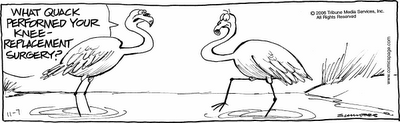
My quack is definitely better than this one!
I enjoyed the following cartoon and want to share it with you...

My quack is definitely better than this one!
Monday, November 06, 2006
Mountain view near Mae Sai, Northern Thailand

Originally uploaded by bhojman.
Yesterday afternoon a friend and I took a drive from Mae Sai up through the mountains to Doi Tung. The scenery was spectacular. We went a bit late in the day so we lost light quite quickly. However, the shades of the evening colour in the mountains was quite lovely.
Friday, November 03, 2006
Burma leader's lavish lifestyle
There's a must see video currently on YouTube showing 10 mins of the July wedding of Than Shwe's daughter in July. The lavishness of the event is in stark contrast to the poverty and suffering being endured by most of the country. If it's true the couple received $5o million worth of wedding gifts then I am truly distressed.n Most do not earn enough to even feed their families, minority groups are continually on the run from the Burmese military, their crops and homes destroyed, their women raped and many forced into slave labour to build roads or be porters for the military.
See the movie at: Burma's "Royal" Wedding
BBC NEWS | Asia-Pacific | Burma leader's lavish lifestyle aired

See the movie at: Burma's "Royal" Wedding
BBC NEWS | Asia-Pacific | Burma leader's lavish lifestyle aired

A video of the wedding of the daughter of Burma's military leader Than Shwe has appeared on the internet, giving a rare glimpse into a lavish lifestyle.
Thandar Shwe and army major Zaw Phyo Win actually married in July, but the video has only recently come to light.
In one 10-minute clip, now on the internet site YouTube, the couple pour large quantities of champagne and stand before an ornate, golden bridal bed.
Thandar Shwe is shown draped in what appear to be expensive jewels.
The newly-weds were reportedly given $50m-worth of wedding gifts, including, cars jewellery and houses.
Most Burmese will not see the video, since internet use inside the repressive country is restricted.
But some of those who have seen the video, both inside and outside Burma, viewed the wedding as a tasteless extravagance in an otherwise poverty-stricken nation.
One local reporter told a Thai newspaper that people were asking themselves where the money came from.
"It's outrageous, just outrageous, especially when you consider that most Burmese live in extreme poverty," Aung Zaw, the editor of Irrawaddy, a publication run by Burmese journalists in exile, told Reuters news agency.
Than Shwe himself is seen in the video, walking stiffly at his daughter's side in traditional Burmese dress - a rare glimpse of him out of military uniform.
Wednesday, November 01, 2006
Security gone amok!
While I appreciate the careful security that is being carried out at airports around the world, it does run amok occasionally. The following article is one such occasion. It's probably a miracle the guy didn't die. I hope Qantas not only apologises but also provides for the medical expenses that resulted.
Security restrictions are applied in rather haphazardly (if at all) in many places and then are over the top in others. While in US recently I fly from one city to another without my id ever being checked... not once was I asked for it. Not only that but carryon bags just went through the system without question about fluids of any kind. On the return journey the security was over the top... everything was checked and I was not allowed to take on board my bottle of water from which I was obviously drinking. No beverages were served on the flight as it was bumpy all the way... I was already rather dehydrated and got more so... Add to that the trip messed with my head and inner ears and I ended up needing to go see an osteopath which cost me $300. Not sure how much lack of fluids contributed but my suspicion is that they contributed quite a lot.
I'm all for the security but surely there are better ways to do it?
Qantas apologises over insulin incident - Travel - smh.com.au
Security restrictions are applied in rather haphazardly (if at all) in many places and then are over the top in others. While in US recently I fly from one city to another without my id ever being checked... not once was I asked for it. Not only that but carryon bags just went through the system without question about fluids of any kind. On the return journey the security was over the top... everything was checked and I was not allowed to take on board my bottle of water from which I was obviously drinking. No beverages were served on the flight as it was bumpy all the way... I was already rather dehydrated and got more so... Add to that the trip messed with my head and inner ears and I ended up needing to go see an osteopath which cost me $300. Not sure how much lack of fluids contributed but my suspicion is that they contributed quite a lot.
I'm all for the security but surely there are better ways to do it?
Qantas apologises over insulin incident - Travel - smh.com.au
Qantas has apologised to a diabetic who fell into a coma after airport staff refused to let him take his insulin on board a flight from Auckland to Christchurch.
The New Zealand Herald reported today Tui Russell, a 43-year-old Auckland chef, was told by check-in staff at Auckland last month he could not take the clearly-labelled medication on board because it was dangerous.
He had a severe attack on the flight and was hospitalised for two weeks after falling into a coma shortly before landing at Christchurch Airport.
Qantas yesterday admitted Mr Russell was "wrongly advised" and apologised, saying passengers were permitted to take essential medication and prescriptions on board in their hand luggage.
Even at the height of the furore over the alleged bomb plot in Britain in August, when liquids such as face creams and sports drinks were banned for international flights, passengers were still allowed to carry on essential non-prescription medicines, including insulin.
Mr Russell told the New Zealand Herald Qantas had offered him a free return flight from Auckland to Christchurch, but he also wanted help from the airline to recover $500 in hospital and medication bills.
NZPA
Monday, October 30, 2006
Gay sex forces closure of store toilets
This summary is not available. Please
click here to view the post.
Tuesday, October 03, 2006
Thailand's new Suvarnabhumi Airport

Suvarnabhumi Airport #3 - one of the huge halls, like a zeppelin hanger
Originally uploaded by bhojman.
I just had to good fortune to come through Thailand's new airport. It is truly an awesomely huge structure despite the teething troubles they've had since it's opening on Thursday. Everything is new, clean, glitzy! It is light and airy and feels very spacious...
I spent several hours up on the 4th floor where there are a lot of shops. They are all still settling in and fixing stuff that doesn't yet work properly.
The biggest lack was places to sit. If you weren't spending money at a food shop then there were no chairs to be had anywhere. I went looking for somewhere to sit and could only find the cement base around the fake palm trees down on the 2nd floor. I think there were plenty of seats in the gate areas.
Once the wrinkles are ironed out I think it might be a rather fun place to travel through.
Saturday, September 30, 2006
Film on Christian children's camp
Not sure what to make of this. I'm all for kids praying as they don't have the hangups we adults do. This idea of terrorists for God doesn't sit well. Jesus instructed his people to love our enemies and to do good to those who hate us. Is this lady encouraging that? I don't know. I probably should see the film before I make a judgement. But I am concerned that it will bring Christianity into disrepute, yet again...
Film on Christian children's camp has cross to bear - World - smh.com.au
Film on Christian children's camp has cross to bear - World - smh.com.au
TWO-YEAR-OLD Ivy's grandfather had serious eye problems, diagnosed as a detached retina. He had surgery, but despite doctors saying the procedure went well, his eyes did not improve.
One day, after a visit to Ivy, he left. When his granddaughter realised he was gone, she ran after him down the street. "Grandpa! Grandpa! Wait I have to do something," she yelled.
He knelt down and said: "What do you have to do?"
"I have to kiss your eyes," she said, and with that she removed his glasses and kissed each one of his eyes and said, "Jesus", then put his glasses back on.
Within a week, grandpa's eyes were totally healed and he was able to go back to work.
This story, and many more like it, are on Becky Fischer's website under the title "Peewee Prophets".
Fischer runs an organisation called Kids in Ministry. She is the central character in a new documentary which raises uncomfortable questions about religious education and politics in the United States.
Jesus Camp is the story of three children, Rachel, now 10, Levi, now 13, and Tory, now 11, and the summer camp they attended last year.
Becky Fischer enlists a group of children as young as six as Christian soldiers in the service of God, as they weep, speak in tongues, collapse and writhe on the floor and find the power of enlightenment.
At one stage Fischer warns the children against Harry Potter. Warlocks, she says sternly, are enemies of God. If Harry Potter had been around in the time of the Old Testament, he would have been put to death.
She frequently uses war terminology, but says it is about a spiritual warfare, not one with guns and other weapons.
On her website, she answers her own questions, such as "Are you raising up Christian terrorists or another Hitler Youth Movement?" and "You are charismatic. Do you represent all evangelical Christians?"
She says: "Christians do believe they are in a cultural war for the lives and souls of people worldwide, and particularly for the minds and hearts of our children and youth."
In the US, the film has been rated PG-13, which means it is recommended that the three children should not see themselves on film. Perhaps the film classification board was concerned about young people being impressionable. The three young stars of the documentary, who attend the camp, are all from evangelical homes in Missouri.
...
Thai army jittery as it moves to quell unrest
Strange events in a peaceful area of Thailand. Looks like someone might be stirring up trouble over the coup. I hope this does not spread and cause more than just a few burnt buildings. Thailand needs to move on... get a new interim government installed and prepare for its new constitution and general elections.
Thai army jittery as it moves to quell unrest - World - smh.com.au
Thai army jittery as it moves to quell unrest - World - smh.com.au
AS INVESTIGATORS pick through the embers at five smouldering schools in central Thailand, the military coup leaders have tightened restrictions on community radio stations to ensure their message is the only one rural Thailand receives.
The army is unsettled by the co-ordinated attack on five remote schools in a sleepy, conservative farming province five hours' drive north of Bangkok with no history of political unrest.
The pragmatic locals know trouble when they see it. With soldiers looking on, the villagers laid flowers amid the still smoking ruins of Baan Chantima school, in Moo 3 village on Thursday, and cursed those who brought politics to their doors.
Initially, the military blamed tensions between teachers, but this has been quickly dismissed. The most likely scenario - an unsettling conclusion for the generals - is that the schools represent the first aggressive opposition to the coup on September 19.
The military has called in Bangkok's Central Institute for Forensic Science to co-ordinate with forensic police. A third army investigation is also under way.
"It is a challenge to the coup people and it is a stronghold for [deposed leader Thaksin Shinawatra's party] Thai Rak Thai," said one man at burnt-out Baan Chantima school who did not wish to be named.
There were more valuable targets to the north, he said on Thursday, such as the heavily armed 3rd Army Command at Phitsanulok, and oilwells. "Perhaps the event took place here because no one would expect it."
It seems an odd place to start a counter-revolution. Kampang Phet province is a Thaksin stronghold, but the rice and sugar-cane growing province is better known for its bird flu outbreaks than revolutionary activity.
....
Baan Chantima school was one of five schools in three districts torched by arsonists. In each case a wooden school building was targeted and the concrete buildings left alone. Two were completely gutted and three partially burnt.
Burning schools are a familiar sight in southern Thailand but are unheard of in central and northern Thailand. "It has never happened before in the nine years I have lived here," said Piyarat Wongmanee, 36, who teaches sixth grade at Baan Chantima.
"Personally, I don't feel like it's the same as the south. It's very peaceful here, nothing like this has ever happened before."
Police Lieutenant-General Somchai Chalermsooksant, the deputy director of the forensic institute, said these attacks were different from the south. "In the south they use branches, tie it with soaked cloth, light it and throw."
The villagers in this remote district now have one thing in common with the south: soldiers on their streets who say they are there to reassure locals that they are still safe.
"Soldiers never visit this place, this is more a police dominance area," one villager said. "People trust the police more than the military here."
Friday, September 29, 2006
Hair Trade !!
I've never thought about hair being a commodity to be traded at any significant level... but apparently it is. I wonder what several tons of the stuff looks like??
Hair Trade Expands into Bangladesh (Burma/Arakan News)
Hair Trade Expands into Bangladesh (Burma/Arakan News)
Hair traders from Arakan State have turned to Bangladesh markets to buy hair from local Bangladeshis for cheaper prices since hair has become a rare commodity in Arakan State, following the exporting of several tons of hair to China a few years back, a local trader reports.
"We are now purchasing several tons of hair from local Bangladesh traders with cheaper prices, but the quality is very poor and very different than hair from Burma," said a hair trader.
In Bangladesh, Arakanese traders can by a kilogram of hair for TK 1,300, and a mung, which is 40 kilograms, for TK 5,200. Strands of hair are TK 2,700 per kilogram and TK 18,000 per mung.
In the hair markets of Rangoon and Mandalay, a viss, or 2.5 kilograms, is 60,000 kyat, while the highest quality hair is priced around 155,000 kyat. After purchase, hair traders from Burma send the hair to the Chinese markets of Yunnan Province.
...
The land down under going under
Now this is something weird... It's what Oz would look like if seas were to rise 300 metres due to global warming. Yikes, my home town is well and truly drowned, as is Sydney and a lot of my favourite places.
I find it rather telling to see something like this and realise that this could be where we're heading if the global warming trend doesn't slow down/stop. It might not be in my lifetime but it would be in someone's lifetime. Not a nice thought... especially given that the whole earth would experience similar drownings of the land. What would this mean for all the people in the world at that time? Where would they fit? It'd be pretty crowded, I guess.
The land down under going under - National - smh.com.au
I find it rather telling to see something like this and realise that this could be where we're heading if the global warming trend doesn't slow down/stop. It might not be in my lifetime but it would be in someone's lifetime. Not a nice thought... especially given that the whole earth would experience similar drownings of the land. What would this mean for all the people in the world at that time? Where would they fit? It'd be pretty crowded, I guess.
The land down under going under - National - smh.com.au
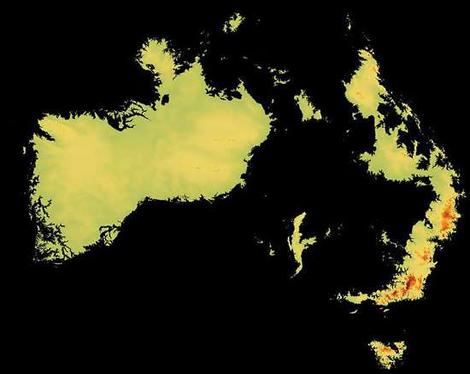
IT IS Australia as we have never seen it before - a dry brown land transformed into an archipelago of disparate islands.
The six images, a fusion of art and science, portray what would happen if sea levels rose by up to 500 metres and the waters inundated the lower-lying regions.
The series is part of an exhibition, Australia from Space, created by a US geographer, Stephen Young, based on images of the continent captured by astronauts and orbiting satellites.
Professor Young, of Salem State College, near Boston, said remote sensing could now reveal extraordinary details about the land, oceans, atmosphere, ice caps and cities.
The starting point of his vision of Australia gradually disappearing was radar information from the space shuttle. Using the map of the rise and fall of the landscape this provided, he calculated how the continent would appear after each additional sea level rise of 100 metres. During the last ice age, about 20,000 years ago, sea levels were 100 metres lower than today.
Extreme global warming might eventually lead to another rise of 100 metres, he said. "And on a longer geological time scale the indundations shown are not out of the realm of possibility."
But his intention in producing the set of images - one of 80 in the exhibition - was not to warn of the dangers of climate change. "The piece was created purely for the beauty of seeing Australia in a different way."
Professor Young began using satellite imagery for his research on changes in vegetation more than a decade ago. "I would often come across truly awe-inspiring images of the Earth."
He hung some on his office walls, and found they were very popular with students. Since 1998 his images of landforms, weather patterns, pollution, oceans and bushfires have been shown in galleries around the world to try to inspire "a sense of wonder and curiosity" about the planet.
The Intergovernmental Panel on Climate Change in its last report predicted sea levels would rise by between nine centimetres and 88 centimetres by 2100.
The two-day exhibition, a collaboration with the NSW Geographical Society, opens today at the University of NSW.
Friday, September 22, 2006
The best breads in town at Kasem's store in Chiang Mai

The best breads in town at Kasem's store in Chiang Mai
Originally uploaded by bhojman.
Kasem's store was just about the very first store in Chiang Mai that started to cater to tastes of foreigners. They have the best breads! They even have really good bagels... not the soft cakey fluffy things you sometimes find being passed off as bagels... but the nice dense variety. Mmmmm are they ever good, and especially slathered in butter and vegemite!
Harbour bridge

It's not often I'm a passenger and able to take photos... but I had a great time one day with a friend and captured this view crossing Sydney's harbour bridge.
Thursday, September 21, 2006
Thai coup leaders claim endorsement by king
If true that the King has endorsed the new government then things will continue to be calm here.
For the first time today I saw a military presence in Chiang Mai. They seemed to be guarding a school, and had lots of children peering into the interior of a troop cariier. Some Thais were taking photos of the soldiers who were holding their weapons in a vigilant yet relaxed manner.
Life goes on here as usual!
Coup leaders claim endorsement by king - World - smh.com.au
For the first time today I saw a military presence in Chiang Mai. They seemed to be guarding a school, and had lots of children peering into the interior of a troop cariier. Some Thais were taking photos of the soldiers who were holding their weapons in a vigilant yet relaxed manner.
Life goes on here as usual!
Coup leaders claim endorsement by king - World - smh.com.au
The leaders of Thailand's coup claim that the king has endorsed their new military government, effectively sealing the deal on the most peaceful coup in Thai history.
In the 48 hours since the tanks rolled onto the streets of Bangkok and deposed caretaker prime minister Thaksin Shinawatra, not one shot has been reported.
A spokesman for army chief General Sonthi Boonyaratglin and other generals in a so-called "Council for Democratic Reform" announced on national television overnight that King Bhumibol Adulyadej had endorsed their actions by royal proclamation.
Mr Thaksin may still have a large supporter base outside Bangkok, but the king receives an almost spiritual reverence from all Thais so if His Majesty thinks it is the best way forward, Thais will follow.
Now that the military has royal backing, the chances of a counter coup appear to have evaporated.
...

Classic photo of a bloodless coup!
Coups in Thailand tend to be fairly bloodless. The worst that occurred since I've been here was in 1992 when the then Thai leader Suchinda sought to crush a popular uprising against his illegal leadership which he gained through a coup the year before. In that 1992 event there were only 50 "official" deaths though many hundreds of people disappeared forever.
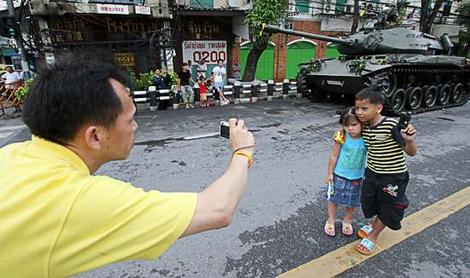
This one has been bloodless and I pray continues to be so. Here's a great photo that says it all... not fear but perhaps a sense of adventure and certainly an event to be celebrated and photographed for posterity.
Ousted and out of touch, PM says he won't give in - World - smh.com.au
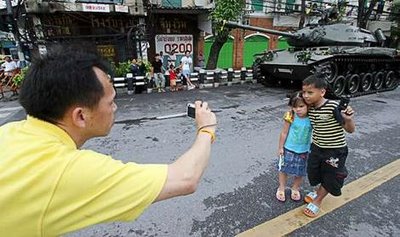
This one has been bloodless and I pray continues to be so. Here's a great photo that says it all... not fear but perhaps a sense of adventure and certainly an event to be celebrated and photographed for posterity.
Ousted and out of touch, PM says he won't give in - World - smh.com.au
THAILAND's caretaker prime minister, Thaksin Shinawatra, has not relinquished his powers and is not seeking asylum following the bloodless military coup in his country, his advisers said last night. ...
Wednesday, September 20, 2006
Muslim animosity strange: Howard
I have to say that I agree with John Howard. The angry reaction of Muslims seems so out of all proportionate to the so called offence. It's almost as if they are looking for ways to pick a fight and to then justify a war. It's madness.
I don't know what the Pope thinks about the Muslims but he is entitled to say whatever he feels is appropriate to the situation. What was the context of the quote? It was a scholarly lecture, for crying out loud! Why is it that the Mulims, and especially the militants are so insecure about themselves and their religion.
They bash Christians. They bash Jews. They probably bash others as well... But do these rise up in anger and fury? Not at all. We might not like the things they call us but they have a right to free speech just as I do.
My freedom of speech does need to be tempered with love, and not driven by hatred. I don't hate Muslims. Those I know are wonderful people and I'm delighted to know them and to count them as friends.
There seems to be something very perverse afoot in the world today. It does not feel good. It's divisive and foments hatred and violence. It's time to stop it before whatever it is takes over the world to all of our destruction.
Muslim animosity strange: Howard - World - smh.com.au
I don't know what the Pope thinks about the Muslims but he is entitled to say whatever he feels is appropriate to the situation. What was the context of the quote? It was a scholarly lecture, for crying out loud! Why is it that the Mulims, and especially the militants are so insecure about themselves and their religion.
They bash Christians. They bash Jews. They probably bash others as well... But do these rise up in anger and fury? Not at all. We might not like the things they call us but they have a right to free speech just as I do.
My freedom of speech does need to be tempered with love, and not driven by hatred. I don't hate Muslims. Those I know are wonderful people and I'm delighted to know them and to count them as friends.
There seems to be something very perverse afoot in the world today. It does not feel good. It's divisive and foments hatred and violence. It's time to stop it before whatever it is takes over the world to all of our destruction.
Muslim animosity strange: Howard - World - smh.com.au
THE Islamic world's angry reaction to comments by Pope Benedict was disproportionate, strange and disappointing, the Prime Minister, John Howard, said last night.
"We should take a deep breath on these things and all have a sense of proportion. We seem to be living in a world where people have no sense of proportion," he told the ABC's Lateline program. "OK, they don't like what was said. I'm sure the Pope was not intending to attack Islam. He's expressed his regrets, and I think we should really move on."
As shadowy threats against the Pope and Christianity multiplied, the Vatican dispatched diplomats to capitals of Muslim states to contain anger. Police patrols were increased around hundreds of churches and mosques in many Western countries.
Despite a personal and public apology from Benedict on Sunday, protests continued on Monday in the Muslim world. Governments everywhere recalled that the row early this year over Danish cartoons depicting the prophet Muhammad flared unexpectedly into violence around the world.
In in some countries, conciliatory voices were emerging, but many Muslims said they remained dissatisfied with Benedict's statement because he said he was "deeply sorry" for the outrage his speech provoked but did not apologise for the remarks themselves.
In his speech last week to academics at Germany's University of Regensburg, where Benedict was a theology professor in the 1970s, the Pope quoted a 14th-century Byzantine emperor who regarded some of the prophet Muhammad's teachings as "evil and inhuman".
Iran's Supreme Leader, Ayatollah Ali Khamenei, alleged the Pope's speech was part of a "crusade against Islam" launched by the US President, George Bush. On the sidelines of a United Nations meeting in New York, Mr Bush told the Malaysian Prime Minister, Abdullah Ahmad Badawi, that Benedict's apology was sincere.
Mr Badawi agreed but cautioned the Pope to avoid making further divisive statements. "I think we can accept it, and we hope there are no more statements that can anger the Muslims," Mr Badawi said.
The Iranian President, Mahmoud Ahmadinejad, expressed respect for Benedict and acknowledged the pontiff had "modified" his remarks. But Morocco's King Mohammed sent a letter to the Vatican to protest against the comments.
Angry protests continued on Monday in India, Pakistan, Indonesia and Iraq. Most of the demonstrations have remained fairly small. Guards have been posted at Christian churches in Egypt and in the West Bank and Gaza Strip, where several were firebombed.
Websites linked with Muslim extremists have posted a batch of threats against the Pope and the Vatican. In Britain, police visited clergy in the London area and were asked to contact their local stations urgently to discuss security.
An Italian nun was shot and killed on Sunday in Somalia after a radical cleric there condemned the Pope's speech. An Italian diplomat and his wife were killed on Monday in Morocco - a country that recalled its ambassador to the Holy See in protest - but Italian officials said the case appeared to be a robbery gone wrong.
The Pope is next expected to address pilgrims during his weekly audience at St Peter's Square tomorrow. The Vatican newspaper L'Osservatore Romano published the Pope's expression of regret on its front page Monday in Italian, French, English and - highlighted in the centre - Arabic. Vatican officials confirmed that plans for Benedict's trip to Turkey, scheduled for late November, remained on track.
The Turkish commentator Selcuk Gultasli said the words of regret from the Vatican were encouraging, and Muslims who compared the Pope to Hitler or who attacked churches and shot at nuns were an embarrassment. The chasm between the Islamic world and the West was larger than ever.
Coup in Thailand!!
Well, it's finally happened! The army have taken control of Thailand in a bloodless and shotless coup... I was here for one in Sept 1985 when I first came, then for another kerfuffle a few years later and here I am again. There's obviously been a lot of dissatisfaction with Thaksin's stubbornness in holding onto power.
The TV here is only broadcasting the King's song. The Thai papers on the internet are not accessible. Schools are closed as are banks and the stock exchange. However, mobile phone networks are still working okay. And, so is the internet... for which I am extremely grateful.
The military who've taken control are wearing a yellow ribbon in honour of the king... and hopefully this means they really have Thailand's welfare at heart. Must away to do other things today.
God bless Thailand's king Bhumipol!
Coup: Thai army in control - World - smh.com.au
The TV here is only broadcasting the King's song. The Thai papers on the internet are not accessible. Schools are closed as are banks and the stock exchange. However, mobile phone networks are still working okay. And, so is the internet... for which I am extremely grateful.
The military who've taken control are wearing a yellow ribbon in honour of the king... and hopefully this means they really have Thailand's welfare at heart. Must away to do other things today.
God bless Thailand's king Bhumipol!
Coup: Thai army in control - World - smh.com.au
The Thai army took control of Bangkok without a shot being fired, dismissed Prime Minister Thaksin Shinawatra, revoked the constitution and promised a swift return to democracy after political reforms.
A government spokesman at the United Nations with Thaksin telephoned a Thai television station to announce a state of emergency in an apparent attempt to head off the coup. He said the army could not succeed and "we're in control".
But tanks and troops took over Government House in Thailand's first coup in 15 years and a coup spokesman said the army and police were in control of the capital and surrounding provinces.
Armoured vehicles and soldiers took up position on many street corners, but life in most of Bangkok continued much as usual with traffic moving through rain drenched streets and the airport operating normally.
The seizure would be temporary and power "returned to the people" soon, retired Lieutenant-General Prapart Sakuntanak said on all Thai television channels.
Foreign news channels, including CNN and the BBC, were cut off.
The army told all soldiers to report to base and banned unauthorised troop movements, suggesting the military leadership was worried that Thaksin loyalists in the armed forces might attempt a counter-coup.
Prapart said the armed forces and police had set up a body to decide on political reforms, ousting billionaire telecoms tycoon Thaksin in the midst of a political crisis stemming from accusations he had subverted Thailand's 74-year-old democracy.
...

Saturday, September 16, 2006
Lines in the sand repost...
Maybe it would be good to be reminded of an Oliphant cartoon which I posted September 3. This is what's at issue with all the jumping up and down the Muslims do whenever anyone says or does anything to which they take exception. The non-Muslim world is being forced to keep taking steps backwards. If we're not careful there'll come a time when our backs are up against the wall and there's no where to go.
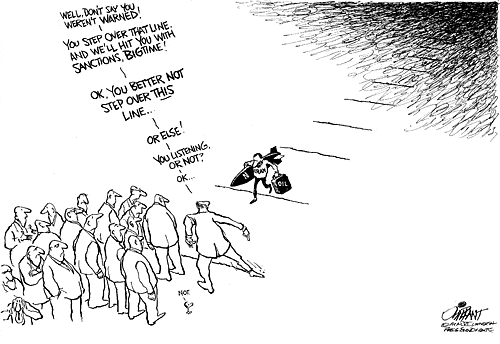
The Pope politcally incorrect... good on him!
The Pope spoke... and, the Muslim world is all stirred up, the fires probably fanned by the same people who fanned the flames after the Danish cartoons.
Why can't he say what he said? If the comments had been about Jews or Chtistians there'd be no reaction whatever. The whole business of politcal correctness is a bunch of hogs wash based on lies. There may have been some value to it once but the whole thing has run amok... and free speech is being curtailed. Even comedians are having to watch what they say!
This has a rather nasty resemblance to what happened during the nazi era. No one stood up to Hitler and all his posturing. The West kept drawing a line in the sand... and Hitler kept moving forward. It has a similar feel now. Then we had WW2! Where are we heading now?
I've come across some interesting work by Pierre Rehov who has been documenting the suicide bombers, trying to understand why they do what they do and why their families are so proud of them and their "sacrifice". Check out the July 27, 2005 Interview with Pierre Rehov, documentary filmmaker, on psychology behind suicide bombings. Also, his website on the Middle East Documentaries that he's made. He has some chilling insights.
I hope the Pope stands his ground!
Malaysia demands apology - World - smh.com.au
Why can't he say what he said? If the comments had been about Jews or Chtistians there'd be no reaction whatever. The whole business of politcal correctness is a bunch of hogs wash based on lies. There may have been some value to it once but the whole thing has run amok... and free speech is being curtailed. Even comedians are having to watch what they say!
This has a rather nasty resemblance to what happened during the nazi era. No one stood up to Hitler and all his posturing. The West kept drawing a line in the sand... and Hitler kept moving forward. It has a similar feel now. Then we had WW2! Where are we heading now?
I've come across some interesting work by Pierre Rehov who has been documenting the suicide bombers, trying to understand why they do what they do and why their families are so proud of them and their "sacrifice". Check out the July 27, 2005 Interview with Pierre Rehov, documentary filmmaker, on psychology behind suicide bombings. Also, his website on the Middle East Documentaries that he's made. He has some chilling insights.
I hope the Pope stands his ground!
Malaysia demands apology - World - smh.com.au
Malaysia's prime minister has demanded Pope Benedict XVI apologise and withdraw his recent remarks about Muslim holy war, the national news agency reported today.
"The Pope must not take lightly the spread of outrage that has been created,'' the Bernama news agency quoted Prime Minister Abdullah Ahmad Badawi as saying. ``The Vatican must now take full responsibility over the matter and carry out the necessary steps to rectify the mistake.''
Muslims from across the world deplored remarks made by Pope Benedict on Islam and many of them said the Catholic leader should apologise in person to dispel the impression he had joined a campaign against their religion.
Influential Turkish legislator Salih Kapusuz fired back today, saying the Pope would go down in history ``in the same category as leaders such as Hitler and Mussolini.''
``He has the dark mentality that comes from the darkness of the Middle Ages,'' Kapusuz said.
Pakistan's legislature condemned Benedict, as did Lebanon's top Shi'ite cleric. "We demand that he apologises personally, and not through (Vatican) sources, to all Muslims for such a wrong interpretation," said Beirut-based Sayyed Mohammad Hussein Fadlallah.
In Gaza, angry Palestinians marched through the streets. "This is another Crusader war against the Arab and Muslim world," said Hamas official Ismail Radwan as he addressed some 5,000 chanting demonstrators.
And in Cairo, Egyptian demonstrators chanted, ``Down with the Pope!''
In Britain, the head of the Muslim Council urged Benedict to ``speak with responsibility and repudiate the Byzantine emperor's views.''
And in Iraq, warring Shi'ites and Sunnis paused from slaughtering each other to condemn the Pope. "This is the second time such an offence has been give before Ramadan," said Sheikh Salah al-Ubeidi, one of the aides to Shi'ite cleric Moqtada al-Sadr, referring to last year's publication of cartoons in a Danish paper sparking violent Muslim protests around the world.
The Muslim Brotherhood, the Arab world's largest group of political Islamists, demanded an apology from the Pope and called on the governments of Islamic countries to break relations with the Vatican if he does not make one.
The Sheikh of al-Azhar, one of the Sunni Muslim world's most prestigious seats of religious studies, said: "The Azhar asserts that these statements indicate clear ignorance of Islam.
"They attribute to Islam what it does not contain," the sheikh, Mohamed Sayed Tantawi, said in a statement on MENA.
Muslim leaders in New York demanded the Pope apologise.
``He is declaring war by his words,'' said Imam Kadhim Mohamad at the Ahlul Bayt Mosque on Atlantic Ave. in Brooklyn. ``He should either apologise or at least prove to the people that what he says is true. Otherwise, he should say nothing.''
more...
Friday, September 15, 2006
Call for frequent flyers to skip airport checks
I reckon something like this could be very helpful for those of us who find ourselves to be frequent flyers. I get soooo tired of standing in line waiting to be checked... and then rechecked at the next place... and then rechecked again at the next place. It's not just the standing in line... it's the frustration of feeling that we're all guilty until proven innocent.
There really has to be a better way. I don't know if the suggestion in the following article is the best way to go, but at least it's a starting point for looking for more effecient ways of dealing with ecurity in air travel.
Call for frequent flyers to skip airport checks - National - smh.com.au
There really has to be a better way. I don't know if the suggestion in the following article is the best way to go, but at least it's a starting point for looking for more effecient ways of dealing with ecurity in air travel.
Call for frequent flyers to skip airport checks - National - smh.com.au
FREQUENT-FLYER benefits could extend to passengers being fast-tracked through aviation security, if the head of Sydney Airport gets his way.
Max Moore-Wilton yesterday outlined a two-tier system for airline passengers: one for those known to airlines as regular and safe passengers, and those who are unknown to airlines.
"I see no reason why regular flyers should be treated as if it's the first time they've been to an airport," said Mr Moore-Wilton, chairman of Sydney Airport Corporation.
He said that within two years a frequent flyer's booking could be tested against a database of personal information - if the Federal Government and overseas authorities give the go-ahead.
"When you went to the airport, there'd be a line for known travellers. You wouldn't have to take off your belt or your shoes.
"This is not about profiling Muslims: it's about people opting in to saying you can assess risk."
Mr Moore-Wilton said his cost-cutting and time-saving proposal was akin to random breath testing. "You don't stop everyone, because you know most have not had too much to drink," he said. "We treat everyone as if they're a potential terrorist. It's dumb."
He acknowledged his views might be seen as contrary to Australian sensitivities about discriminatory treatment. "That's a particularly old-fashioned view. We see differentiation in every part of society."
A spokesman for the Transport Minister, Warren Truss, said the proposition had been informally discussed and would be further considered as part of the "constant review of aviation security".
Addressing the Focus on Business conference in Canberra, Mr Moore-Wilton said it was questionable whether the tripling of security costs at Sydney Airport - to $48 million a year - or the $US5 billion annual increase in global aviation security since September 11, 2001 were value for money.
He said balance was needed between security screening and "the relatively free flow of people".
Otherwise, he said, widespread chaos resulted, as it did in Britain with the recent in-flight ban on liquids and gels. "Passengers were standing in line for hours," Mr Moore-Wilton said. "Thousands of bags missed flights … and hundreds of flights were cancelled.
"This is not to say that it is not legitimate to meet the public expectations about security. However, the financial impacts, the assessed risk and the effectiveness of the introduced measures all need to be carefully considered."
He said airport security was "least efficient" in the area of human involvement. "Security is relatively low paid, with relatively low skills. That will have to change to interface with increasingly sophisticated technology."
Tuesday, September 12, 2006
Lost, twice!!
Some people don't seem to learn from their mistakes... or so it seems with this guy in Central Australia!
He gets himself lost, not once but twice... and in the same area. The heat must have addled his brain!
Lost British tourist found a second time - Breaking News - National - Breaking News
He gets himself lost, not once but twice... and in the same area. The heat must have addled his brain!
Lost British tourist found a second time - Breaking News - National - Breaking News
A 50-year-old British tourist missing in bush north of Alice Springs has been found by searchers for the second time in a week.
The man sparked a major air and ground search last Tuesday after he called police on his mobile phone and told them he was lost.
He said he had gone walking on tracks near the Old Telegraph Station on Sunday, September 3 and had become disorientated.
He was eventually found and taken to hospital suffering sunburn and dehydration.
Tuesday at about 12.40pm (CST) the man called police from his mobile phone to say he was lost again in roughly the same area.
He had gone walking around the Old Telegraph Station again and had been lost since Friday.
Police mounted an air and ground search and found him five hours later, about 4.6km north-east of the Telegraph Station.
The tourist - again suffering dehydration - was taken to hospital and is undergoing medical assessment.
© 2006 AAP
More landgrabbing in Burma
The ordinary people in Burma continue to suffer to whims of those in charge. Paddy fields belong to someone, they're not just land laying around waiting to be grabbed by military or civil servants.
The usual role of the military and civil servants is to protect the citizens of the country, not to take advantage of them.
It's time for this sort of behaviour to stop and care about the country and all its people!
Land grabbing for Burma new capital (Democratic Voice of Burma)
The usual role of the military and civil servants is to protect the citizens of the country, not to take advantage of them.
It's time for this sort of behaviour to stop and care about the country and all its people!
Land grabbing for Burma new capital (Democratic Voice of Burma)
A Burmese civil servant admitted that the ruling military government’s plan to make the new administrative capital Kyappyay Naypyidaw populated by allocating 8000 plots of land for new buildings, involved confiscation of lands from local farmers living between Pyinmna and Lewe.
“Yes. There is a plan to allocate plots of land measuring 80x80, 100x100, 120x120 (feet?). The price has not been fixed. They haven’t said it yet,” the civil servant from the capital’s municipal department said. “There are 4000 plots on the way to Lewe and 4000 plots to be created at the areas adjoining the army and civilian lands. Application forms are not sold, but you could apply for them at Naypyidaw Municipal (office).”
When asked who originally owned the lands, the civil servant said: “There are various kinds in this matter. They are paddy fields of the villages. Some of them are paddy fields. I don’t know about that”.
But when asked how many acres of paddy fields had been confiscated, the civil servant refused to answer the question.
According to a local resident in nearby Pyinmana, the majority of the people are neither interested in the government’s project nor applying for the plots.
'Rat's disease' in Thailand's North
I've never heard of leptospirosis or of 'rat's disease'. It does not sound at all pleasant.
There are quite a few mysterious ailments that seem to be connected with tropical areas. Apparently a person can have this particular disease and not show any symptoms... my question in that case is, 'Is it still causing liver and spleen damage?'
'Rat's disease' takes 31 lives in the North (Bangkok Post : General news)
There are quite a few mysterious ailments that seem to be connected with tropical areas. Apparently a person can have this particular disease and not show any symptoms... my question in that case is, 'Is it still causing liver and spleen damage?'
'Rat's disease' takes 31 lives in the North (Bangkok Post : General news)
Leptospirosis, also known as "rat's disease," has killed 31 and infected thousands of villagers in flood-hit areas of the North, a senior health official said yesterday.
Disease Control Department chief Thawat Sundarajarn said the disease is spreading in flooded areas of Nan Province, and over 1,400 cases have already been reported in Muang, Pua, Ta Wang Pa and Wiang Sa districts.
"The leptospirosis outbreak is more severe this year due to the long inundation period and a high fatality rate in the North," he said.
The disease is an infection caused by rat urine which contaminates water and wet river banks. The bacteria in the urine does not survive for long in dry conditions and the disease is mostly found in tropical areas such as Thailand, India, China, Malaysia, Indonesia and countries in Latin America.
The epidemic is usually at its peak during the rainy season between August and September and can occur in areas struck by natural disasters such as floods and earthquakes. Humans can contract the disease by either coming into contact with an infected rat or its urine. Dogs, cats, cows and buffaloes can also be carriers of the disease, Dr Thawat said.
Symptoms of the flu-like disease are high fever, muscle pain and red eyes, which eventually leads to liver and spleen failure if left untreated.
Around 350,000-500,000 leptospirosis cases are recorded around the world each year.
In Thailand, where at least 2,000 people get infected each year, most cases are reported in the northeastern and northern provinces. So far, there were more than 13,000 suspected cases in Nan province alone this year, said Dr Thawat.
The country's most severe outbreak of leptospirosis occurred back in 1999 with 14,285 infections and 362 fatalities.
As a precaution, Dr Thawat said people in flooded areas should avoid walking barefoot on damp and wet ground. "You should immediately see a doctor if your foot gets infected in the floods for urgent diagnosis and treatment," he said.
Monday, September 11, 2006

Steve Irwin (SMH Obituary)
Celebrating the life of Steve Irwin, the following obituary appeared in today's Sydney Morning Herald.
Steve was a passionate man who lived a passionate life and remained true to the ideals he espoused.
May God give comfort to his wife, Terri, and the children, Bindi and Bob, as well as all his close friends and colleagues at Australia Zoo and around the world.
Wildlife warrior took his passion to the world - Obituaries - smh.com.au
Steve was a passionate man who lived a passionate life and remained true to the ideals he espoused.
May God give comfort to his wife, Terri, and the children, Bindi and Bob, as well as all his close friends and colleagues at Australia Zoo and around the world.
Wildlife warrior took his passion to the world - Obituaries - smh.com.au
Steve Irwin, 1962-2006
Stephen Robert Irwin, killed by a stingray off the Great Barrier Reef last Monday, knew throughout the last decade of his life, when he enjoyed superstardom, that two things were true: he was one miscalculation away from doom; and if such a thing happened, detractors would say: "It was only a matter of time."
But he amounted to far more than that. If he did offend some traditional naturalists - and critics like Germaine Greer - he brought an awareness of wildlife to living rooms throughout the world and imbued in his listeners a respect for all creatures, even those they had been taught to revile.
Born in Essendon, in Melbourne's north-west, Irwin was destined to grow up, as were his sisters Joy and Mandy, in what was from outward appearances a normal family. His father, Bob, was a plumber and his mother, Lyn, a maternity nurse. Irwin loved sport and barracked for the Essendon Bombers in the AFL. The family took holidays and explored parks and creeks. But it was the couple's private passion, wildlife, that instilled itself in the young Steve, who was also to learn quickly that some of those beloved creatures did not necessarily appreciate the attention. When he was four, a cockatoo bit him badly on the nose.
For his sixth birthday, Irwin asked for a snake and his father, an amateur herpetologist, thought that was fair enough. While other children watched The Flintstones, Steve Irwin was catching mice for Fred, a 2.6 metre python.
At seven, he was following his father into the bush, trying to catch snakes as his father did, and barely surviving an attack by a brown snake. Once, having batted poorly in a cricket match, Irwin went looking for lizards, found a red-bellied black snake and thought the best place to transport it home on the bus was in the driver's esky. The driver was not impressed.
In 1970, following their dream, the family moved to Queensland's Sunshine Coast and founded the Beerwah Reptile Park. Lyn filled the house with injured and orphaned native animals, turning her nursing skills to bottle-feeding joeys in home-made pouches that swung from kitchen chairs. Bob taught his son to catch animals being exhibited, including crocodiles. Steve initially helped his father who "jumped" the crocodile. The boy would use his weight to pin the reptile down while his father blindfolded it. Then when Steve was nine, they reversed roles, when the boy jumped a one-metre "freshie".
After completing his schooling at Caloundra State High, Irwin joined the Queensland Government's program of trapping and relocating rogue crocodiles in the state's north. Taking his best friend, a dog called Chilli, a small boat, ropes and nets to trap the crocodiles too big to jump, he worked alone for months on end. He relocated many crocodiles to the property at Beerwah, including Acco, the 1000-kilogram "saltie" that had feasted on cattle for 20 years.
In 1991, Irwin's parents handed over to him the running of the wildlife park and he changed its name to Australia Zoo. He also began the Channel Ten documentary series, Totally Wild, which is still running. The same year he met John Stainton, who was to become his great mate and financial partner. The following year he met Terri Raines, a vet from Oregon who had a keen interest in American wildlife rehabilitation. She asked him whether he had a girlfriend, he said he did and whistled for his Staffordshire bull terrier cross, Sui. Eight months later Steve and Terri married, and invited a camera crew on their honeymoon to film the rescue of a crocodile.
In 1996, with Stainton's backing, Irwin became host of The Crocodile Hunter series, co-starring with Terri and using the services of Sui, and it thrust him into public awareness. He and his wife made more than 100 wildlife documentaries. He appeared to be showing off, almost to be taunting the crocodiles and snakes. He was often bitten, but he had a sense of humour.
Cherrie Bottger, now an executive with Channel Ten, said the first time she went with a crew to produce a segment for Totally Wild at Australia Zoo, she exhibited a phobia about snakes. The idea of a wildlife film producer having such problems sent Irwin into fits of laughter. "But he always made me feel comfortable and instructed the staff to keep the snakes away from me," she said.
Irwin certainly took risks, pushed the boundaries of safety for what he believed in. Terri Irwin once said: "People tune in because they want to see this guy die or get badly hurt. But instead they get a message about wildlife, and they get to see a guy who says, 'Isn't a rattlesnake beautiful?' Who else says that?" And who will now? What Steve Irwin saw as ordinary, most of us would call extraordinary. What Steve saw as awesome was the beauty of creatures others fear - or misunderstand. And Steve devoted his life to conveying his sense of awe to the rest of the world.
Irwin was never inclined to be cautious, or to spare himself. Trevor Long, the marine science director for Sea World, said he was once with Irwin on a boat, catching turtles for the Queensland Parks and Wildlife Service. Disregarding questions about his safety, Irwin dived and badly fractured a finger. Coming up, he said it was only dislocated and gave it a yank. "You could see the wave of pain go across his face." Long said. "But Steve said, 'I will strap it up', and he did and continued catching turtles for the rest of the day."
Irwin's first child was Bindi Sui, named after Irwin's favourite crocodile, Bindi, and Sui. She was born on July 24, 1998. By 1999, through cable TV series, some 200 million viewers - many of whom were in the US - had been drawn into his private enthusiasm. He had become the new Paul Hogan, the archetypal Australian "good bloke", the de facto ambassador for all that was best in his country.
The environmentalist, Dr David Suzuki, said: "Most academic environmentalists speak as if they have a pole up their behind but Steve Irwin vulgarised environmental issues in the best possible way and so popularised them to the extreme. The environmental world benefited enormously from Steve Irwin because he not only identified threatened species but hugged and kissed them, making the viewers want to save them as well."
Those who preferred the academic refinement of David Attenborough hardly warmed to Irwin, and his detractors had plenty to work on. A son, Robert Clarence, born on December 1 , 2003, was little more than a month old - too weak even to hold up his head - when Irwin took him in one arm into a crocodile pen. With the other arm, Irwin dangled a chicken carcass over the gaping mouth of a large crocodile.
Irwin, with his wife's support, said Bob was in no danger and that each of their children was going to be taught to be "croc savvy". But Irwin barely escaped a charge of child endangerment.
Irwin worked tirelessly to raise public awareness of conservation issues and bought expanses of land in several countries as part of his dream to extend the family legacy with protected parklands around the globe.
He found himself in a further spot of bother when he was filmed too close to Antarctic wildlife. That probably was the problem: he wanted to get too near.
But in April he launched his own conservation organisation, Wildlife Warriors. Its executive director, Michael Hornby, said: "We are now even more committed than ever to carry on what Steve started. Our charter includes buying land, when funds become available, and we will continue the education process he started so well."
At the time of his death, Irwin was shooting material to be used in Bindi Sui's wildlife documentary series for kids. Bindi had been brought up well. Irwin remarked with some pride on Enough Rope, Andrew Denton's ABC TV show, that she had received "her first snakebite". Obviously her father's daughter, she said at age eight that she harboured an ambition to run Australia Zoo.
Malcolm Brown and Wendy Anderson
Forced relocation and land grabbing in central Burma
The iniquitous behaviour of the Burmese military continues. Now they are trying to grab land that does not belong to them... and to force the relocation of those who are the legitimate landowners.
Do they have no conscience at all?
Forced relocation and land grabbing in central Burma (Democratic Voice of Burma)
Do they have no conscience at all?
Forced relocation and land grabbing in central Burma (Democratic Voice of Burma)
The authorities of Meikhtila Township in central Burma and regional military officers have ordered local residents of 200 households to move their homes within 21 days from 25 September, on the pain of being prosecuted for encroaching on army-owned lands.
The order was issued on 25 August with the signature of Khin Maung Soe, the township chief administrator, and it was the second time the ‘notice letter’ was issued, a local resident told DVB.
“The ward authority members came to give us that letter, but people from the ward couldn’t accept it. Last time, we accepted it. This time, we told them that we could not accept their letter and sent them back.”
He added that the first notice letter only told residents to move out but they are very incensed by the second as it includes the threats of forced relocation and prosecution. Residents have decided to stay put and local Buddhist monks volunteered to protect them and intercede for them.
The army claims that the land belongs to nearby army-owned textile factory and accused the residents of being squatters. The residents insisted that their land doesn’t belong to the army as they can prove they bought the land with contracts long before the army built the factory.
A similar attempt of land grabbing was made by an army officer some years ago at the same place, but he was told to give up his claim by his superiors after some investigations.
Sunday, September 10, 2006
RIGHTS-BURMA: Ethnic Minorities Starved, Denied Medical Care
The disgraceful behaviour of the Burmese leadership and the military continues. And the suffering of the minority groups escalates. So many have been internally displaced that the numbers border on the unimaginable. Yet, life does go on and the spirit of those on the receiving end has not been broken. Fear abounds but the desire for life and freedom has not been quenched.
RIGHTS-BURMA: Ethnic Minorities Starved, Denied Medical Care
RIGHTS-BURMA: Ethnic Minorities Starved, Denied Medical Care
To be a health worker along Burma's eastern borders, home to the Karen and Karenni ethnic communities, is to court death, injury or imprisonment, say doctors working in the area.
Even midwives have not been spared. One in her mid-50s was arrested and tortured, they add.
Such abuse by Burma's military regime on health workers are only part of a grim picture in the border areas that have been laid waste by the junta's policy of crippling the health and food distribution systems where the ethnic minorities live.
This continuing abuse has created a humanitarian crisis that places the Karen and Karenni victims on par with, or even worse than, victims in war-ravaged African countries like Rwanda, Somalia and Sierra Leone, say the doctors who are leading relief efforts inside Burma.
''Maternal mortality rates are higher than in Rwanda,'' Dr. Mahn Mahn said at a news conference here earlier this week. ''The internally displaced people in eastern Burma face a chronic humanitarian crisis.''
''Pregnant women cannot access obstetric emergency services. They cannot even have blood transfusions,'' added Dr. Cynthia Maung. ''Health workers cannot carry medicines to help communities. They cannot be identified as health workers. It is very dangerous for them.''
The doctors who are part of a novel health care service -- the Backpack Health Worker Team (BPHWT) -- made these comments at the launch of the first ever report on the health of internally displaced people (IDPs) in eastern Burma, where Rangoon's troops are locked in a decades-old battle with ethnic rebel groups.
The maternal mortality rates (MMR) among the IDPs is between 1,000 - 1,200 deaths to 100,000 live births, states the 81-page 'Chronic Emergency: Health and Human Rights in Eastern Burma.' The MMR rates in Somalia, by contrast, is 1,100 deaths for every 100,000 live births, is 990 deaths in the Democratic Republic of the Congo (DRC) and 1,400 deaths in Rwanda.
Read on...
Friday, September 08, 2006
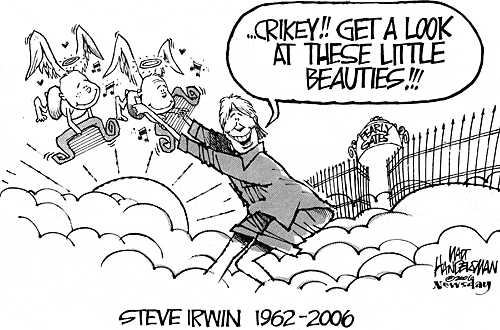
Sunday, September 03, 2006
Saturday, September 02, 2006
Parts of ancient wall in Chiang Mai collapse
After a long silence, I'm getting back to blogging... I've been away from Chiang Mai for a couple of months and have just returned. The wet season is well under way and lots of rain has fallen here in the north of Thailand.
The result? Chiang Mai is falling apart! The rain seems to be seeping down into the cracks of some of the ancient structures of the old city causing them to fall apart. Chang Puek gate (white elephant gate) is the latest victim.
Parts of ancient wall in Chiang Mai collapse (Bangkok Post)
The result? Chiang Mai is falling apart! The rain seems to be seeping down into the cracks of some of the ancient structures of the old city causing them to fall apart. Chang Puek gate (white elephant gate) is the latest victim.
Parts of ancient wall in Chiang Mai collapse (Bangkok Post)

Parts of the 700-year-old wall in downtown Chiang Mai collapsed yesterday after heavy downpours. The ancient Chang Phuak Gate, or Gate of the White Elephant, partially collapsed. It forms part of a long ancient wall in the centre of Chiang Mai, surrounded by a moat.
Officials expect further damage to the wall because more cracks have been found. Persistent heavy rain is thought to have seeped through the cracks, weakening the wall's foundations.
The ancient wall dates back to 1276, during the reign of King Mang Rai.
Chiang Mai mayor Boonlert Buranapakorn said officials were preparing to restore the wall.
He also told officials to prevent further damage to other ancient structures in the city, including almost a dozen run-down pagodas. Torrential rain earlier brought down a 505-year-old pagoda in Chiang Mai municipality. Heavy rain has lashed Chiang Mai in the past few weeks. ...
Subscribe to:
Posts (Atom)