I enjoyed the following cartoon and want to share it with you...

My quack is definitely better than this one!

Yesterday afternoon a friend and I took a drive from Mae Sai up through the mountains to Doi Tung. The scenery was spectacular. We went a bit late in the day so we lost light quite quickly. However, the shades of the evening colour in the mountains was quite lovely.
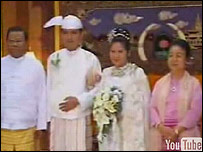
A video of the wedding of the daughter of Burma's military leader Than Shwe has appeared on the internet, giving a rare glimpse into a lavish lifestyle.
Thandar Shwe and army major Zaw Phyo Win actually married in July, but the video has only recently come to light.
In one 10-minute clip, now on the internet site YouTube, the couple pour large quantities of champagne and stand before an ornate, golden bridal bed.
Thandar Shwe is shown draped in what appear to be expensive jewels.
The newly-weds were reportedly given $50m-worth of wedding gifts, including, cars jewellery and houses.
Most Burmese will not see the video, since internet use inside the repressive country is restricted.
But some of those who have seen the video, both inside and outside Burma, viewed the wedding as a tasteless extravagance in an otherwise poverty-stricken nation.
One local reporter told a Thai newspaper that people were asking themselves where the money came from.
"It's outrageous, just outrageous, especially when you consider that most Burmese live in extreme poverty," Aung Zaw, the editor of Irrawaddy, a publication run by Burmese journalists in exile, told Reuters news agency.
Than Shwe himself is seen in the video, walking stiffly at his daughter's side in traditional Burmese dress - a rare glimpse of him out of military uniform.
Qantas has apologised to a diabetic who fell into a coma after airport staff refused to let him take his insulin on board a flight from Auckland to Christchurch.
The New Zealand Herald reported today Tui Russell, a 43-year-old Auckland chef, was told by check-in staff at Auckland last month he could not take the clearly-labelled medication on board because it was dangerous.
He had a severe attack on the flight and was hospitalised for two weeks after falling into a coma shortly before landing at Christchurch Airport.
Qantas yesterday admitted Mr Russell was "wrongly advised" and apologised, saying passengers were permitted to take essential medication and prescriptions on board in their hand luggage.
Even at the height of the furore over the alleged bomb plot in Britain in August, when liquids such as face creams and sports drinks were banned for international flights, passengers were still allowed to carry on essential non-prescription medicines, including insulin.
Mr Russell told the New Zealand Herald Qantas had offered him a free return flight from Auckland to Christchurch, but he also wanted help from the airline to recover $500 in hospital and medication bills.
NZPA

I just had to good fortune to come through Thailand's new airport. It is truly an awesomely huge structure despite the teething troubles they've had since it's opening on Thursday. Everything is new, clean, glitzy! It is light and airy and feels very spacious...
I spent several hours up on the 4th floor where there are a lot of shops. They are all still settling in and fixing stuff that doesn't yet work properly.
The biggest lack was places to sit. If you weren't spending money at a food shop then there were no chairs to be had anywhere. I went looking for somewhere to sit and could only find the cement base around the fake palm trees down on the 2nd floor. I think there were plenty of seats in the gate areas.
Once the wrinkles are ironed out I think it might be a rather fun place to travel through.
TWO-YEAR-OLD Ivy's grandfather had serious eye problems, diagnosed as a detached retina. He had surgery, but despite doctors saying the procedure went well, his eyes did not improve.
One day, after a visit to Ivy, he left. When his granddaughter realised he was gone, she ran after him down the street. "Grandpa! Grandpa! Wait I have to do something," she yelled.
He knelt down and said: "What do you have to do?"
"I have to kiss your eyes," she said, and with that she removed his glasses and kissed each one of his eyes and said, "Jesus", then put his glasses back on.
Within a week, grandpa's eyes were totally healed and he was able to go back to work.
This story, and many more like it, are on Becky Fischer's website under the title "Peewee Prophets".
Fischer runs an organisation called Kids in Ministry. She is the central character in a new documentary which raises uncomfortable questions about religious education and politics in the United States.
Jesus Camp is the story of three children, Rachel, now 10, Levi, now 13, and Tory, now 11, and the summer camp they attended last year.
Becky Fischer enlists a group of children as young as six as Christian soldiers in the service of God, as they weep, speak in tongues, collapse and writhe on the floor and find the power of enlightenment.
At one stage Fischer warns the children against Harry Potter. Warlocks, she says sternly, are enemies of God. If Harry Potter had been around in the time of the Old Testament, he would have been put to death.
She frequently uses war terminology, but says it is about a spiritual warfare, not one with guns and other weapons.
On her website, she answers her own questions, such as "Are you raising up Christian terrorists or another Hitler Youth Movement?" and "You are charismatic. Do you represent all evangelical Christians?"
She says: "Christians do believe they are in a cultural war for the lives and souls of people worldwide, and particularly for the minds and hearts of our children and youth."
In the US, the film has been rated PG-13, which means it is recommended that the three children should not see themselves on film. Perhaps the film classification board was concerned about young people being impressionable. The three young stars of the documentary, who attend the camp, are all from evangelical homes in Missouri.
...
AS INVESTIGATORS pick through the embers at five smouldering schools in central Thailand, the military coup leaders have tightened restrictions on community radio stations to ensure their message is the only one rural Thailand receives.
The army is unsettled by the co-ordinated attack on five remote schools in a sleepy, conservative farming province five hours' drive north of Bangkok with no history of political unrest.
The pragmatic locals know trouble when they see it. With soldiers looking on, the villagers laid flowers amid the still smoking ruins of Baan Chantima school, in Moo 3 village on Thursday, and cursed those who brought politics to their doors.
Initially, the military blamed tensions between teachers, but this has been quickly dismissed. The most likely scenario - an unsettling conclusion for the generals - is that the schools represent the first aggressive opposition to the coup on September 19.
The military has called in Bangkok's Central Institute for Forensic Science to co-ordinate with forensic police. A third army investigation is also under way.
"It is a challenge to the coup people and it is a stronghold for [deposed leader Thaksin Shinawatra's party] Thai Rak Thai," said one man at burnt-out Baan Chantima school who did not wish to be named.
There were more valuable targets to the north, he said on Thursday, such as the heavily armed 3rd Army Command at Phitsanulok, and oilwells. "Perhaps the event took place here because no one would expect it."
It seems an odd place to start a counter-revolution. Kampang Phet province is a Thaksin stronghold, but the rice and sugar-cane growing province is better known for its bird flu outbreaks than revolutionary activity.
....
Baan Chantima school was one of five schools in three districts torched by arsonists. In each case a wooden school building was targeted and the concrete buildings left alone. Two were completely gutted and three partially burnt.
Burning schools are a familiar sight in southern Thailand but are unheard of in central and northern Thailand. "It has never happened before in the nine years I have lived here," said Piyarat Wongmanee, 36, who teaches sixth grade at Baan Chantima.
"Personally, I don't feel like it's the same as the south. It's very peaceful here, nothing like this has ever happened before."
Police Lieutenant-General Somchai Chalermsooksant, the deputy director of the forensic institute, said these attacks were different from the south. "In the south they use branches, tie it with soaked cloth, light it and throw."
The villagers in this remote district now have one thing in common with the south: soldiers on their streets who say they are there to reassure locals that they are still safe.
"Soldiers never visit this place, this is more a police dominance area," one villager said. "People trust the police more than the military here."
Hair traders from Arakan State have turned to Bangladesh markets to buy hair from local Bangladeshis for cheaper prices since hair has become a rare commodity in Arakan State, following the exporting of several tons of hair to China a few years back, a local trader reports.
"We are now purchasing several tons of hair from local Bangladesh traders with cheaper prices, but the quality is very poor and very different than hair from Burma," said a hair trader.
In Bangladesh, Arakanese traders can by a kilogram of hair for TK 1,300, and a mung, which is 40 kilograms, for TK 5,200. Strands of hair are TK 2,700 per kilogram and TK 18,000 per mung.
In the hair markets of Rangoon and Mandalay, a viss, or 2.5 kilograms, is 60,000 kyat, while the highest quality hair is priced around 155,000 kyat. After purchase, hair traders from Burma send the hair to the Chinese markets of Yunnan Province.
...
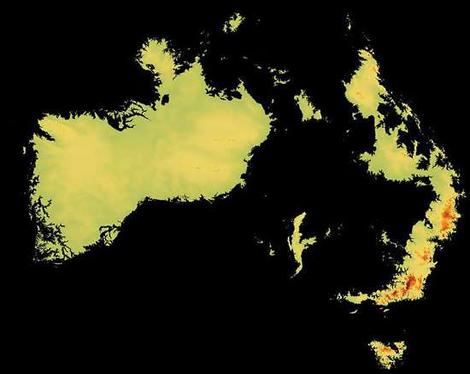
IT IS Australia as we have never seen it before - a dry brown land transformed into an archipelago of disparate islands.
The six images, a fusion of art and science, portray what would happen if sea levels rose by up to 500 metres and the waters inundated the lower-lying regions.
The series is part of an exhibition, Australia from Space, created by a US geographer, Stephen Young, based on images of the continent captured by astronauts and orbiting satellites.
Professor Young, of Salem State College, near Boston, said remote sensing could now reveal extraordinary details about the land, oceans, atmosphere, ice caps and cities.
The starting point of his vision of Australia gradually disappearing was radar information from the space shuttle. Using the map of the rise and fall of the landscape this provided, he calculated how the continent would appear after each additional sea level rise of 100 metres. During the last ice age, about 20,000 years ago, sea levels were 100 metres lower than today.
Extreme global warming might eventually lead to another rise of 100 metres, he said. "And on a longer geological time scale the indundations shown are not out of the realm of possibility."
But his intention in producing the set of images - one of 80 in the exhibition - was not to warn of the dangers of climate change. "The piece was created purely for the beauty of seeing Australia in a different way."
Professor Young began using satellite imagery for his research on changes in vegetation more than a decade ago. "I would often come across truly awe-inspiring images of the Earth."
He hung some on his office walls, and found they were very popular with students. Since 1998 his images of landforms, weather patterns, pollution, oceans and bushfires have been shown in galleries around the world to try to inspire "a sense of wonder and curiosity" about the planet.
The Intergovernmental Panel on Climate Change in its last report predicted sea levels would rise by between nine centimetres and 88 centimetres by 2100.
The two-day exhibition, a collaboration with the NSW Geographical Society, opens today at the University of NSW.

Kasem's store was just about the very first store in Chiang Mai that started to cater to tastes of foreigners. They have the best breads! They even have really good bagels... not the soft cakey fluffy things you sometimes find being passed off as bagels... but the nice dense variety. Mmmmm are they ever good, and especially slathered in butter and vegemite!
It's not often I'm a passenger and able to take photos... but I had a great time one day with a friend and captured this view crossing Sydney's harbour bridge.
The leaders of Thailand's coup claim that the king has endorsed their new military government, effectively sealing the deal on the most peaceful coup in Thai history.
In the 48 hours since the tanks rolled onto the streets of Bangkok and deposed caretaker prime minister Thaksin Shinawatra, not one shot has been reported.
A spokesman for army chief General Sonthi Boonyaratglin and other generals in a so-called "Council for Democratic Reform" announced on national television overnight that King Bhumibol Adulyadej had endorsed their actions by royal proclamation.
Mr Thaksin may still have a large supporter base outside Bangkok, but the king receives an almost spiritual reverence from all Thais so if His Majesty thinks it is the best way forward, Thais will follow.
Now that the military has royal backing, the chances of a counter coup appear to have evaporated.
...
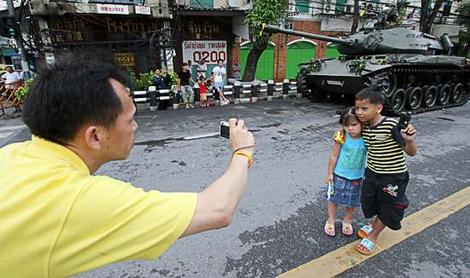
THAILAND's caretaker prime minister, Thaksin Shinawatra, has not relinquished his powers and is not seeking asylum following the bloodless military coup in his country, his advisers said last night. ...
THE Islamic world's angry reaction to comments by Pope Benedict was disproportionate, strange and disappointing, the Prime Minister, John Howard, said last night.
"We should take a deep breath on these things and all have a sense of proportion. We seem to be living in a world where people have no sense of proportion," he told the ABC's Lateline program. "OK, they don't like what was said. I'm sure the Pope was not intending to attack Islam. He's expressed his regrets, and I think we should really move on."
As shadowy threats against the Pope and Christianity multiplied, the Vatican dispatched diplomats to capitals of Muslim states to contain anger. Police patrols were increased around hundreds of churches and mosques in many Western countries.
Despite a personal and public apology from Benedict on Sunday, protests continued on Monday in the Muslim world. Governments everywhere recalled that the row early this year over Danish cartoons depicting the prophet Muhammad flared unexpectedly into violence around the world.
In in some countries, conciliatory voices were emerging, but many Muslims said they remained dissatisfied with Benedict's statement because he said he was "deeply sorry" for the outrage his speech provoked but did not apologise for the remarks themselves.
In his speech last week to academics at Germany's University of Regensburg, where Benedict was a theology professor in the 1970s, the Pope quoted a 14th-century Byzantine emperor who regarded some of the prophet Muhammad's teachings as "evil and inhuman".
Iran's Supreme Leader, Ayatollah Ali Khamenei, alleged the Pope's speech was part of a "crusade against Islam" launched by the US President, George Bush. On the sidelines of a United Nations meeting in New York, Mr Bush told the Malaysian Prime Minister, Abdullah Ahmad Badawi, that Benedict's apology was sincere.
Mr Badawi agreed but cautioned the Pope to avoid making further divisive statements. "I think we can accept it, and we hope there are no more statements that can anger the Muslims," Mr Badawi said.
The Iranian President, Mahmoud Ahmadinejad, expressed respect for Benedict and acknowledged the pontiff had "modified" his remarks. But Morocco's King Mohammed sent a letter to the Vatican to protest against the comments.
Angry protests continued on Monday in India, Pakistan, Indonesia and Iraq. Most of the demonstrations have remained fairly small. Guards have been posted at Christian churches in Egypt and in the West Bank and Gaza Strip, where several were firebombed.
Websites linked with Muslim extremists have posted a batch of threats against the Pope and the Vatican. In Britain, police visited clergy in the London area and were asked to contact their local stations urgently to discuss security.
An Italian nun was shot and killed on Sunday in Somalia after a radical cleric there condemned the Pope's speech. An Italian diplomat and his wife were killed on Monday in Morocco - a country that recalled its ambassador to the Holy See in protest - but Italian officials said the case appeared to be a robbery gone wrong.
The Pope is next expected to address pilgrims during his weekly audience at St Peter's Square tomorrow. The Vatican newspaper L'Osservatore Romano published the Pope's expression of regret on its front page Monday in Italian, French, English and - highlighted in the centre - Arabic. Vatican officials confirmed that plans for Benedict's trip to Turkey, scheduled for late November, remained on track.
The Turkish commentator Selcuk Gultasli said the words of regret from the Vatican were encouraging, and Muslims who compared the Pope to Hitler or who attacked churches and shot at nuns were an embarrassment. The chasm between the Islamic world and the West was larger than ever.
The Thai army took control of Bangkok without a shot being fired, dismissed Prime Minister Thaksin Shinawatra, revoked the constitution and promised a swift return to democracy after political reforms.
A government spokesman at the United Nations with Thaksin telephoned a Thai television station to announce a state of emergency in an apparent attempt to head off the coup. He said the army could not succeed and "we're in control".
But tanks and troops took over Government House in Thailand's first coup in 15 years and a coup spokesman said the army and police were in control of the capital and surrounding provinces.
Armoured vehicles and soldiers took up position on many street corners, but life in most of Bangkok continued much as usual with traffic moving through rain drenched streets and the airport operating normally.
The seizure would be temporary and power "returned to the people" soon, retired Lieutenant-General Prapart Sakuntanak said on all Thai television channels.
Foreign news channels, including CNN and the BBC, were cut off.
The army told all soldiers to report to base and banned unauthorised troop movements, suggesting the military leadership was worried that Thaksin loyalists in the armed forces might attempt a counter-coup.
Prapart said the armed forces and police had set up a body to decide on political reforms, ousting billionaire telecoms tycoon Thaksin in the midst of a political crisis stemming from accusations he had subverted Thailand's 74-year-old democracy.
...
Malaysia's prime minister has demanded Pope Benedict XVI apologise and withdraw his recent remarks about Muslim holy war, the national news agency reported today.
"The Pope must not take lightly the spread of outrage that has been created,'' the Bernama news agency quoted Prime Minister Abdullah Ahmad Badawi as saying. ``The Vatican must now take full responsibility over the matter and carry out the necessary steps to rectify the mistake.''
Muslims from across the world deplored remarks made by Pope Benedict on Islam and many of them said the Catholic leader should apologise in person to dispel the impression he had joined a campaign against their religion.
Influential Turkish legislator Salih Kapusuz fired back today, saying the Pope would go down in history ``in the same category as leaders such as Hitler and Mussolini.''
``He has the dark mentality that comes from the darkness of the Middle Ages,'' Kapusuz said.
Pakistan's legislature condemned Benedict, as did Lebanon's top Shi'ite cleric. "We demand that he apologises personally, and not through (Vatican) sources, to all Muslims for such a wrong interpretation," said Beirut-based Sayyed Mohammad Hussein Fadlallah.
In Gaza, angry Palestinians marched through the streets. "This is another Crusader war against the Arab and Muslim world," said Hamas official Ismail Radwan as he addressed some 5,000 chanting demonstrators.
And in Cairo, Egyptian demonstrators chanted, ``Down with the Pope!''
In Britain, the head of the Muslim Council urged Benedict to ``speak with responsibility and repudiate the Byzantine emperor's views.''
And in Iraq, warring Shi'ites and Sunnis paused from slaughtering each other to condemn the Pope. "This is the second time such an offence has been give before Ramadan," said Sheikh Salah al-Ubeidi, one of the aides to Shi'ite cleric Moqtada al-Sadr, referring to last year's publication of cartoons in a Danish paper sparking violent Muslim protests around the world.
The Muslim Brotherhood, the Arab world's largest group of political Islamists, demanded an apology from the Pope and called on the governments of Islamic countries to break relations with the Vatican if he does not make one.
The Sheikh of al-Azhar, one of the Sunni Muslim world's most prestigious seats of religious studies, said: "The Azhar asserts that these statements indicate clear ignorance of Islam.
"They attribute to Islam what it does not contain," the sheikh, Mohamed Sayed Tantawi, said in a statement on MENA.
Muslim leaders in New York demanded the Pope apologise.
``He is declaring war by his words,'' said Imam Kadhim Mohamad at the Ahlul Bayt Mosque on Atlantic Ave. in Brooklyn. ``He should either apologise or at least prove to the people that what he says is true. Otherwise, he should say nothing.''
more...
FREQUENT-FLYER benefits could extend to passengers being fast-tracked through aviation security, if the head of Sydney Airport gets his way.
Max Moore-Wilton yesterday outlined a two-tier system for airline passengers: one for those known to airlines as regular and safe passengers, and those who are unknown to airlines.
"I see no reason why regular flyers should be treated as if it's the first time they've been to an airport," said Mr Moore-Wilton, chairman of Sydney Airport Corporation.
He said that within two years a frequent flyer's booking could be tested against a database of personal information - if the Federal Government and overseas authorities give the go-ahead.
"When you went to the airport, there'd be a line for known travellers. You wouldn't have to take off your belt or your shoes.
"This is not about profiling Muslims: it's about people opting in to saying you can assess risk."
Mr Moore-Wilton said his cost-cutting and time-saving proposal was akin to random breath testing. "You don't stop everyone, because you know most have not had too much to drink," he said. "We treat everyone as if they're a potential terrorist. It's dumb."
He acknowledged his views might be seen as contrary to Australian sensitivities about discriminatory treatment. "That's a particularly old-fashioned view. We see differentiation in every part of society."
A spokesman for the Transport Minister, Warren Truss, said the proposition had been informally discussed and would be further considered as part of the "constant review of aviation security".
Addressing the Focus on Business conference in Canberra, Mr Moore-Wilton said it was questionable whether the tripling of security costs at Sydney Airport - to $48 million a year - or the $US5 billion annual increase in global aviation security since September 11, 2001 were value for money.
He said balance was needed between security screening and "the relatively free flow of people".
Otherwise, he said, widespread chaos resulted, as it did in Britain with the recent in-flight ban on liquids and gels. "Passengers were standing in line for hours," Mr Moore-Wilton said. "Thousands of bags missed flights … and hundreds of flights were cancelled.
"This is not to say that it is not legitimate to meet the public expectations about security. However, the financial impacts, the assessed risk and the effectiveness of the introduced measures all need to be carefully considered."
He said airport security was "least efficient" in the area of human involvement. "Security is relatively low paid, with relatively low skills. That will have to change to interface with increasingly sophisticated technology."
A 50-year-old British tourist missing in bush north of Alice Springs has been found by searchers for the second time in a week.
The man sparked a major air and ground search last Tuesday after he called police on his mobile phone and told them he was lost.
He said he had gone walking on tracks near the Old Telegraph Station on Sunday, September 3 and had become disorientated.
He was eventually found and taken to hospital suffering sunburn and dehydration.
Tuesday at about 12.40pm (CST) the man called police from his mobile phone to say he was lost again in roughly the same area.
He had gone walking around the Old Telegraph Station again and had been lost since Friday.
Police mounted an air and ground search and found him five hours later, about 4.6km north-east of the Telegraph Station.
The tourist - again suffering dehydration - was taken to hospital and is undergoing medical assessment.
© 2006 AAP


